


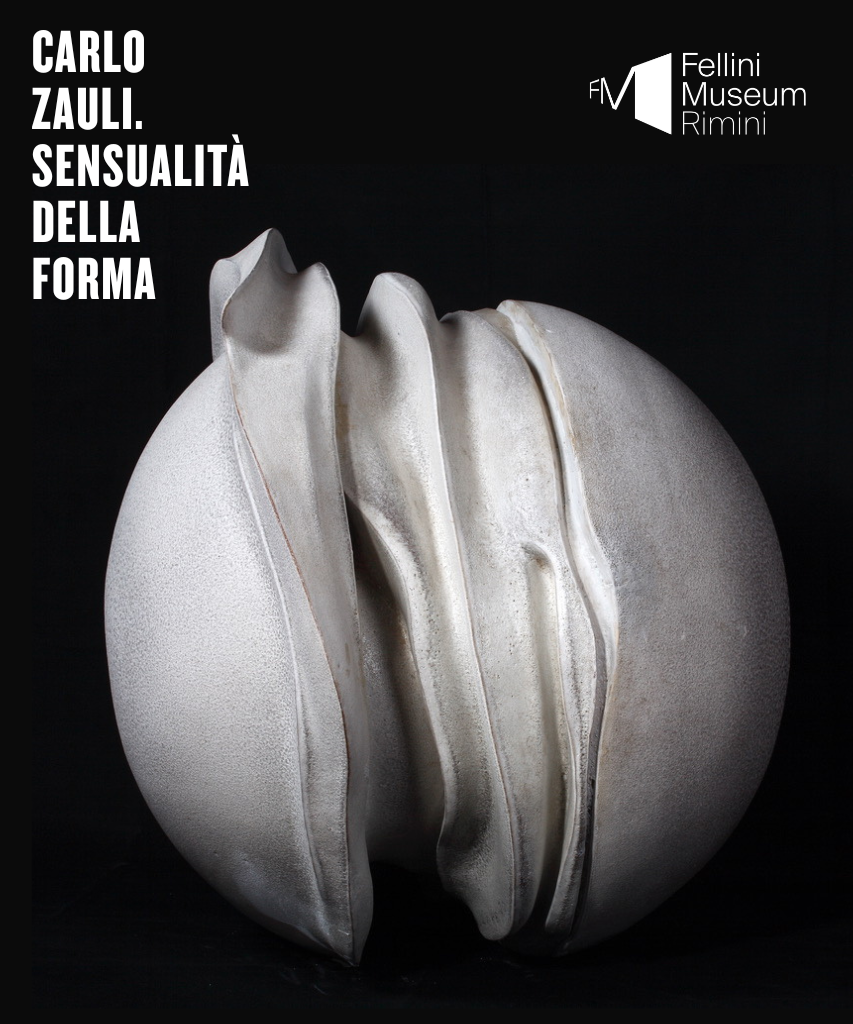
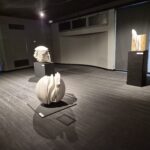
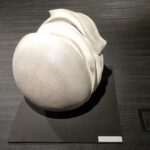
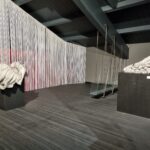
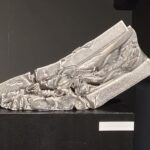
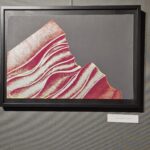
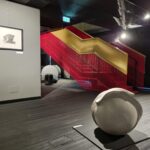
The exhibition Sensualità della Forma at Palazzo del Fulgor, home to Fellini Museum run by the Municipality of Rimini, curated by Monica and Matteo Zauli, features sculptures, lithographs and etchings from Carlo Zauli Museum in Faenza.
One of the leading figures in Italian ceramics and sculpture of the late 20th century, Carlo Zauli succeeded in transforming a material deeply rooted in tradition into a contemporary language, capable of engaging with sculpture, architecture and the international artistic trends of his time. His works gradually move away from the functional dimension of the object to explore the expressive power of pure form, giving rise to volumes that seem to expand, breathe and change under the viewer’s gaze. In each piece, a dialogue is established between structure and geometric order, on one hand, and material supple naturalness, on the other – a relationship that is heightened by Zauli’s characteristic colour palette. An expressive universe that is, on this occasion, also transported beyond the realm of sculpture and comes to life in the two-dimensionality of the graphic work – a truly new aspect of this exhibition which brings Fellini’s movie atmospheres into dialogue with the artistic exploration developed during the same historical period by the artist from Faenza.
The dialogue between Zauli and Fellini is rooted in a human and poetic affinity: both hailed from Romagna, both are connected to an imaginative dimension of reality, and they share a vision where form is permeated by vital emotional and sensual tensions. Zauli’s works thus resound with the visionary universe of the director of 8½: a world of metamorphosis, desire and images suspended between dream and matter.
Housed within Palazzo del Fulgor, Sensualità della Forma creates a unique dialogue between two artists who have made transformation a milestone of their creative practice. On one hand, Fellini’s cinema, populated by figures poised between memory and imagination; on the other, Zauli’s works which seem to emerge from the earth to take on an almost materic presence. A juxtaposition that reveals unexpected affinities and celebrates the profound link between art, matter and imagination.
With this exhibition, Palazzo del Fulgor continues its programme of exhibitions dedicated to contemporary artists whose work resonates with some of the central themes of Fellini’s films. It is not a direct tribute to the Rimini-born director, but rather an exploration of affinities, influences and echoes that transcend different artistic languages.
Carlo Zauli was born in Faenza in 1926 to Tea and Berto. His childhood and teenage years established him as a promising young footballer. He made his debut for his hometown’s first team at the age of fourteen and was scouted by major clubs, including Fiorentina and Milan, who invited him for trials; however, Carlo never attended these as, a few weeks later, in June 1943, the top-flight clubs’ football activities came to a halt due to the war. In the summer of 1944, he was then deported, along with his father, to a Nazi forced-labour camp in Hülz, in the Ruhr area, from which he returned, extremely debilitated, a year later. Back home, he resumed his football career and completed his studies in ceramics, specialising in the technical field he had begun before the war. In 1949, together with three school friends, he took over a historic workshop in the city centre, which later became his studio—first a workshop and then the Carlo Zauli Museum. Thanks to his friendship with more experienced masters and his contacts with the finest Italian ceramists who came to Faenza for the already prestigious “Premio Faenza” for contemporary ceramics, he soon developed his craft towards more artistic outcomes, winning the coveted first prize in 1953, at the age of just 27. This marked the beginning of a career that, from the late 1950s onwards, saw him create public works in Italy and the Middle East (for the Royal Palace in Baghdad, the State Printing House in Kuwait, and the Hilton Hotel in Tehran) and hold solo exhibitions in Rome, Milan and Madrid. From the late 1960s, having already created dozens of monumental public works, his artistic language evolved towards a more naturalistic, post-informal style of sculpture, characterised by an original and distinctive choice of colour: the famous ‘Zauli white’. It was from this period that his international success took hold, remaining with him until the mid-1990s. In addition to his many solo exhibitions in Europe, there were major exhibition cycles in Japan, where Zauli was the most beloved and widely represented Italian artist of his time. This success was further cemented by his work as a ceramic designer in the United States, Canada and Brazil. In 1989, he was the first Italian artist invited to hold a solo exhibition in Moscow, in the Soviet Union during the perestroika era. The 1990s saw him still engaged in numerous solo exhibitions, which gradually became less frequent due to the onset of an illness that rapidly sapped his creative energy. His work is present in 40 museums worldwide and in numerous public spaces.